Part of my "How to Teach English at Home" series.
Introduction
Reading is one of the main pillars of learning English. It is something that can come naturally to some, and be more complicated for others. This is an area a lot of home-educating parents worry about, especially if they are not teachers or found reading tricky themselves when growing up.
The best thing about reading is that development happens gradually over time and you do not need expensive programmes or textbooks to be able to access reading. With a little organisation and preparation, reading can actually become one of the most enjoyable and stable parts of your home education journey and can often be seen as a pleasure, rather than a chore.
Reading Starts with Phonics
For our very young children (who we call ‘early readers’), they will begin learning to read by using phonics. Phonics is where a child learns how letters and sounds work together. They begin to match certain sounds to certain letters and use this to decode (break down sounds to be able to read) words and begin reading.
Once children are able to decode and sound out words, they are then able to recognise and memorise different words and this is the next stepping stone to learning to read.
As children get more and more confident with decoding words, they are then able to read with more fluency (speed and accuracy) and build up comprehension (understanding) of what they are reading.
Teaching phonics to early readers might seem a little daunting at first, but it is entirely possible to teach your child, as a home educator, with no teaching experience necessary! Check out my How to Teach Phonics at Home (A Beginner’s Guide for Parents of Early Readers) article to learn more about phonics, how to get started and where to look for free resources to help.
The Four Stages of Learning to Read
Here are four stages that children go through, from first opening picture books, to fluently reading chapter books by themselves. Keep in mind that everyone learns at different paces and at different ages. Some of these stages may take a couple of years while others might take a couple of months.
Stage 1: Pre-reading
Pre-reading starts with exposure to picture books, stories, rhymes and generally becoming away of any kind of writing around them. The pre-reading stage typically includes:
-
Listening to stories
-
Learning nursery rhymes
-
Talking about books
-
Recognising environmental print such as famous logos, STOP signs, their own names, brand names (like LEGO) etc.
Stage 2: Learning to Decode
The next stage is early reading. It includes your child beginning to:
-
Sounding out words
-
Blending sounds together
-
Reading simple phonically decodable books
Stage 3: Building Fluency
Once your child is able to decode and read text, including tricky words, they begin to read independently, still using phonics to decode more complex new vocabulary. This stage is characterised by:
-
Reading becomes smoother
-
Less effort spent decoding
-
Greater confidence
Stage 4: Reading for Meaning
Once your child is a fluent reader, the focus shifts away from decoding language, and more towards understanding language. They are able to begin:
-
Understanding characters
-
Making predictions
-
Discussing books
-
Independent reading
How to Teach Reading at Home: A Simple Daily Routine
There are so many different ways that you can build reading into your daily homeschooling routine. Here are 4 routine ideas, showing how to focus on different areas of reading.
|
Routine |
Focus |
What it includes |
|
Read & Talk |
Comprehension |
Your child reads independently for 10-20 minutes, followed by a short discussion about the story (characters, events, and simple questions like “What happened?” or “What did you enjoy?”). |
|
Shared Reading |
Accuracy and understanding |
You and your child take turns reading aloud, pausing to discuss vocabulary, clarify meaning, and make predictions about what might happen next. |
|
Fluency Focus |
Expression and confidence |
Your child re-reads a familiar book to practise fluency, expression, and pace. You could model a short section and give specific feedback to them. |
|
Choice-Based Reading |
Motivation and enjoyment |
Your child chooses their own reading material (books, comics, magazines, non-fiction) and reads independently, followed by a relaxed conversation or optional creative response (e.g. drawing or one-sentence summary). |
When you think about your daily reading routine, keep in mind that reading consistently is so much more effective than reading in one big chunk: it is much better to read for 20 minutes every day rather than 2 hours once a week.
How Long Should My Child Read for Each Day?
This is a very common question and my honest answer to this is that there is no single “perfect” amount of time that is recommended. Each child and family is different, but here are some rough guidelines. Don’t forget that the guidelines will vary for each child depending on (and not limited to) their age, confidence and reading stage.
A realistic daily guide
15–20 minutes per day: Suitable for reluctant readers or very busy days. This is enough to maintain progress and build a consistent habit.
20–30 minutes per day: A typical and very effective range for most independent readers. This allows time for reading plus a short discussion or follow-up activity.
30–45 minutes per day: Ideal for confident or enthusiastic readers, or for homeschooling families who want to build deeper reading habits. This may be spread across the day.
Rather than timing reading, consider:
Consistency: Did my child read today?
Engagement and understanding: Are they interested in what they are reading? Do they understand what they are reading? Can we have a short conversation about what they read today?
Variety: Are they trying different types of reading across the week? Including independent reading, shared reading, and re-reading.
Reading mindset: Is reading a positive, enjoyable part of the day? Are they enjoying their book?
Reading Aloud Is More Powerful Than Most Parents Realise
Once children begin to read independently, many parents tend to move to solely allowing their children to read independently. What many people do not realise is that reading aloud to your child has many benefits that continue, even after your children can read for themselves.
Not only is it an enjoyable family moment, but it allows your child to continue to explore books that might be above their own reading level. Exposure to texts slightly higher than their actual level has many benefits, including:
-
Building vocabulary
-
Improving comprehension
-
Introducing more complex language stuctures
-
Creating or continuing positive associations with books
How to Improve Reading Comprehension
Once your children begin to be more independent with their reading, it is important to keep in touch with them about what they are reading. This will allow you to see how they are doing: are the books they are reading too easy or too challenging? By discussing books, you are also helping them to reflect on their reading, form their own opinions and elaborate their thoughts to enhance their own understanding.
Here is what improving reading comprehension could look like at home:
Before reading:
-
Discuss the title of the story
-
Identify the author (and illustrator if there is one)
-
Talk about the cover illustration
-
Read the blurb together
-
Predict what might happen
During reading:
-
Pause occasionally
-
Ask simple questions to check understanding
-
Look up unfamiliar vocabulary
After reading:
-
Retell the story so far
-
Discuss your favourite parts
-
Explain why characters acted as they did
What to Do if Your Child Is a Reluctant Reader
This is one of the most common issues that parents come across regarding reading. Some parents might have children who love reading and read for hours every day; others may have children who absolutely refuse to read; and others (like me!) have children who go through phases and may love reading for a few weeks and then be much more reluctant in other weeks.
My main advice in these situations is:
-
Follow their interests: allow them to read around a subject that they love
-
Let them choose books: you should guide them but if they are set on reading a particular book then let them!
-
Remember that ALL reading counts: comics, magazines, recipe books, instruction manuals, audiobooks…
-
Show that you value reading: read together, take it in turns, read yourself, discuss books you are reading together
-
Reading should be fun: avoid turning reading everybook into a lesson. If they just want to read but resist talking about books, do not force it. Keep reading enjoyable!
-
Reread favourites: repetition helps to build confidence and fluency - my 9 year old still enjoys a bit of the Gruffalo in the evening!
Building a Home Reading Culture
Reading can become one of the most calm, enjoyable and rewarding times of the day for home educating families. In order to encourage a positive reading culture at home think about the following ideas:
-
Let children see adults reading
-
Visit libraries regularly
-
Keep books accessible
-
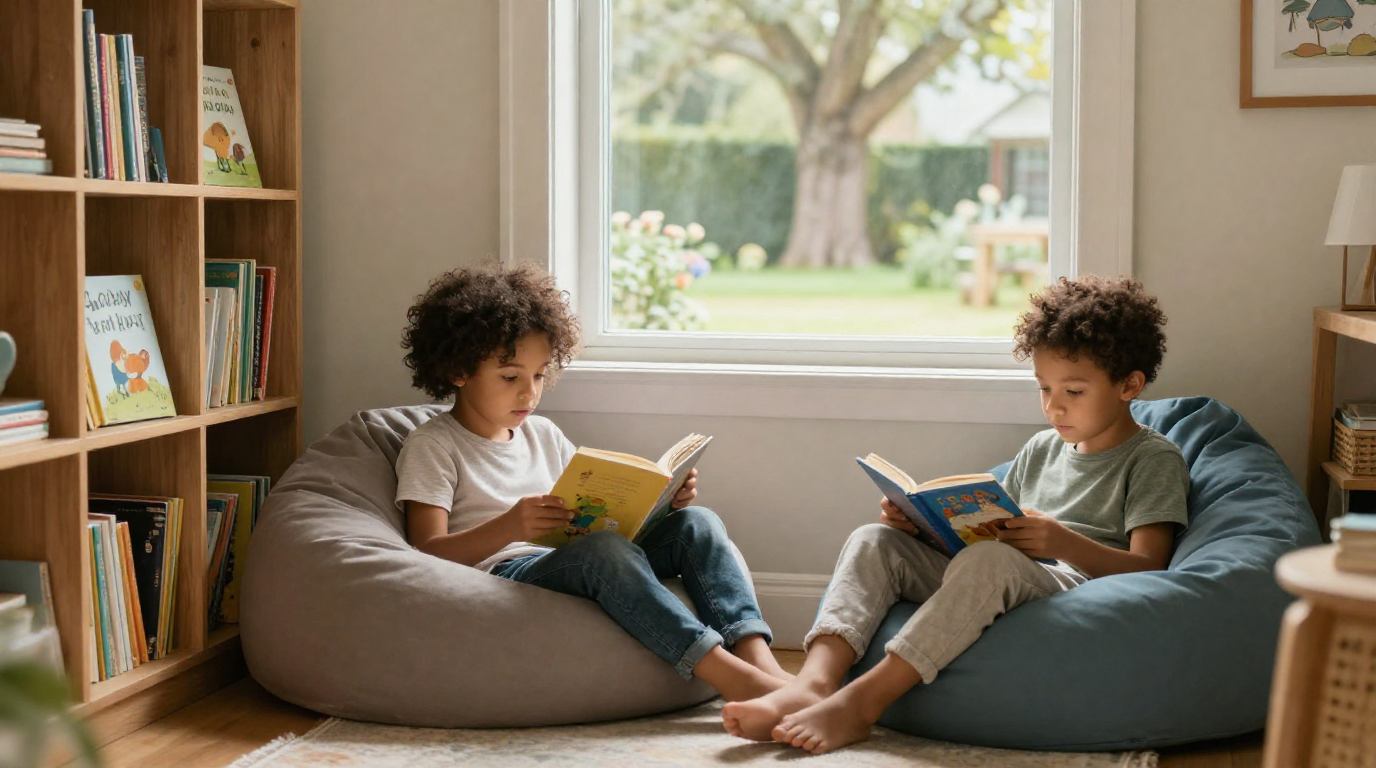
Create a cosy reading corner
-
Read together as a family
-
Celebrate books without using rewards
-
Ask for books (or vouchers) as presents for birthdays and celebrations
Free UK Reading Resources for Homeschooling Families
Oxford Owl
-
Free eBooks
-
Reading guidance
-
Phonics support
BookTrust
-
Book recommendations by age
-
Reading activities
-
Family reading support
BBC Bitesize English
-
Reading comprehension activities
-
English lessons
National Literacy Trust
-
Reading support
-
Literacy advice
-
Home learning resources
Words for Life
-
Activities and reading ideas for families
Final thoughts
It is so important to keep in mind that: Every Child's Reading Journey Looks Different. Reading (as with all other skills) develops and progresses at different rates. It is rarely linear; you might find that your child makes zooming progress in just a few weeks and then it plateaus for the next few months. In this case, consistency is far more important: reading for a little while every single day is much better than for an hour once per week. It is important to keep in mind that enjoying reading is just as important as reading accuracy - avoid over correcting if your child is making mistakes as this takes the enjoyment out of reading aloud. Create a home reading culture and see it become one of your favourite parts of each homeschooling day!
Related reading
Learning how to teach reading at home is an important part of homeschooling, but it is only one piece of providing a well-rounded education. Understanding how reading fits into the wider homeschooling journey can help you support your child's learning with confidence.
For a complete overview, you can explore the full guide here: The Complete Guide to Homeschooling