Homeschool
Supporting Your Child’s Needs at Home: Using Maslow’s Pyramid
Learn how you, as home educating parents, can use Maslow’s Hierarchy of Needs to support your children’s well-being, motivation, and self-actualisation at home.
Understanding Maslow’s Hierarchy of Needs in Home Education
As a teacher, one of the most important lessons I learned during training was this: motivation and well-being REALLY matter. Understanding why a learner is sometimes eager and other times reluctant is key to helping them flourish. Now, as a home educating parent, I see this daily in my own children — their ability to focus and enjoy learning is deeply connected to whether their basic needs are being met.
Think for a moment about your own child: have they ever struggled to concentrate on a task, perhaps because they were hungry or tired? Or maybe they felt anxious or unsettled in a new environment and couldn’t focus at all? On the other hand, when their basic needs are met — when they feel secure, fed, rested, and supported — they can immerse themselves in learning and approach challenges with curiosity and confidence. Often, the difference between engagement and resistance comes down to whether their physiological and emotional needs are being met.
What is Maslow’s Hierarchy of Needs?
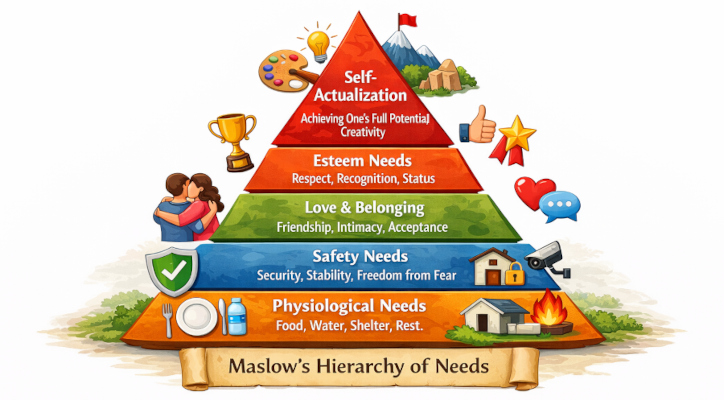
Abraham Maslow, a psychologist, introduced his theory in 1943, presenting a five-tier model of human needs, often depicted as a pyramid. The idea is simple: humans have basic needs that must be met before higher-level growth and development can flourish.
The five levels of Maslow’s hierarchy are:
-
Physiological Needs – Basic survival requirements, such as food, water, warmth, and rest.
-
Safety Needs – The need for security and protection from harm, including physical and emotional safety.
-
Love and Belonging – Social relationships, friendships, family connections, and a sense of inclusion.
-
Esteem – Respect, self-esteem, recognition, and personal achievement.
-
Self-Actualisation – Realising personal potential, creativity, problem-solving, and achieving meaningful goals.
Maslow suggested that lower-level needs must be reasonably satisfied before higher-level needs can become a priority. In educational contexts, this means a child struggling with hunger, fear, or social anxiety will find it harder to focus on learning or personal growth.
How It Works in Schools
In traditional school settings, teachers often consider Maslow’s hierarchy—often intuitively—when managing classrooms:
-
Physiological Needs: ensuring children have access to breakfast clubs or snacks.
-
Safety Needs: maintaining a safe and predictable classroom environment.
-
Love and Belonging: fostering friendships, teamwork, and a sense of community.
-
Esteem: praising achievements, giving responsibilities, and recognising effort.
-
Self-Actualisation: encouraging exploration, creativity, and independent thinking.
Teachers may notice that a child who is struggling socially or physically is less able to engage with challenging tasks. Meeting the lower-level needs creates the foundation for more meaningful learning.
How It Works in Home Education
As a home education parent, you have the unique advantage of tailoring your approach to your child’s individual needs. Let’s explore each level of Maslow’s hierarchy in a home setting, with practical tips and examples.
1. Physiological Needs
Ensuring your child’s physical well-being is the first step to supporting learning at home.
-
Provide nutritious meals and snacks to maintain energy throughout the day.
-
Maintain consistent bedtime routines to promote restful sleep.
-
Include movement and outdoor breaks to support physical health and release excess energy.
-
Consider environmental factors: a comfortable chair, adequate lighting, and room temperature all contribute to a child’s ability to focus.
Reflective question: Does my child have the physical foundation to engage fully with learning each day?
2. Safety Needs
Feeling safe at home is essential for learning and emotional growth.
-
Create consistent daily routines so your child knows what to expect.
-
Maintain a calm, emotionally supportive atmosphere, especially during challenging lessons.
-
Designate a comfortable learning space where distractions are minimised and your child can focus.
Example: If a child fears making mistakes, they may avoid difficult tasks. Encouraging a “mistakes are learning” mindset and gently guiding them through challenges supports both safety and confidence.
Reflective question: How does my child respond to changes or unexpected events in their day?
3. Love and Belonging
Children need to feel connected and valued, both at home and in the wider community.
-
Spend quality family time together — meals, games, or reading sessions.
-
Arrange social interactions through clubs, group activities, or playdates.
-
Encourage open communication about feelings and experiences, showing that emotions are valid and heard.
Example: A child struggling socially might benefit from a small, consistent group of peers rather than a large, overwhelming class setting. Home education allows you to tailor these interactions.
Reflective question: Does my child feel connected and valued within our home and community?
4. Esteem
Confidence and self-worth are powerful motivators.
-
Celebrate achievements, big and small, to help children internalise success.
-
Encourage independence by allowing your child to make choices in learning topics or presentation formats.
-
Use positive reinforcement and affirming language that recognises effort, not just results.
Example: Instead of saying, “You got 10 out of 10,” try: “I love how you kept trying different strategies until you solved it — your persistence really paid off!” This focuses on growth rather than just the outcome.
Reflective question: How do I acknowledge and encourage my child’s efforts and successes?
5. Self-Actualisation
Self-actualisation is about helping your child reach their potential and pursue passions.
-
Offer opportunities to explore interests and hobbies in depth.
-
Encourage creative projects and independent problem-solving.
-
Present challenges that stretch abilities while remaining achievable, fostering resilience.
Example: If your child loves drawing, allow them to research artists, experiment with techniques, or even create a small exhibition at home. These experiences nurture curiosity and self-expression.
Reflective question: Am I providing space for my child to explore, create, and grow according to their unique talents?
Practical Tips for Applying Maslow at Home
-
Observe and respond to your child’s physical and emotional needs before expecting academic focus.
-
Create routines that balance structure and freedom, helping children feel secure while encouraging autonomy.
-
Encourage reflection: ask your child what makes them feel safe, supported, and excited about learning.
-
Mix short-term goals (completing a project) with long-term growth (mastery of skills), aligning with all levels of Maslow’s hierarchy.
Final Thoughts
Understanding Maslow’s Hierarchy of Needs helps you, as home education parents, create an environment where your children feel supported, secure, and motivated. Meeting each level of need allows your child to focus on learning and reach their potential.
Every child progresses at their own pace, and so your role is to guide and provide the conditions for growth. By attending to these needs thoughtfully, you help your child flourish and develop their love of learning — empowering them one step at a time. Home education is more than teaching subjects; it’s about supporting the whole child, physically, emotionally, socially, and intellectually.
Other articles you might be interested in
Homeschool
Homeschooling Philosophies Explained: How to Define Your Own Home Education Approach
Discover different homeschooling philosophies and learn how to define a home educat

Homeschool
Motivation Matters: Intrinsic and Extrinsic Motivation in Home Education
Learn the difference between intrinsic and extrinsic motivation in home education a

Homeschool
Creating Your Learning Ethos at Home
Learn how to create a strong homeschooling learning ethos with practical tips for routines, r