Homeschool
Homeschooling Philosophies Explained: How to Define Your Own Home Education Approach
Discover different homeschooling philosophies and learn how to define a home education approach that suits your child, your family, and your lifestyle.
Introduction
Starting home education can feel overwhelming. There are so many decisions to make: curriculums, schedules, resources, online inspiration, Pinterest-perfect setups. It’s easy to get lost in comparison or feel like you’re “doing it wrong.” You may even find yourself trying to replicate the aesthetics or routines of other families, thinking that if it works for them, it should work for you.
But home education is at its best when it comes from your own beliefs about learning, your family’s rhythm, and your child’s unique needs. Taking a step back to define your personal educational philosophy can make everything feel more natural. It’s not just for beginners; home educating veteran families often find it helpful to revisit and refine their approach as their children grow because what suited your child as a 5 year old, is not necessarily going to work the same way with them as a 15 year old.
Before choosing a curriculum, buying resources, or planning timetables, ask yourself one question: What do I actually believe about education? This blog article will explore common educational philosophies and give you practical ways to start defining your own approach.
What Is an Educational Philosophy?
An educational philosophy, simply put, is a set of beliefs about:
-
What education is for: Is it about knowledge, character, creativity, or a mixture?
-
How children learn best: Does your child thrive with structured lessons, curiosity-led exploration, or hands-on experiences?
-
The role of the parent: Are you a guide, facilitator, teacher, or a mix of all three?
If you think about it, logically speaking, every family already has a philosophy, it just hasn't been written down. Some parents realise it through trial and error, whereas others may have a clear sense from the start. And importantly, your philosophy can evolve. What you decide now doesn’t have to be set in stone. It can grow with your child and your confidence as a home educator.
A Snapshot of Common Educational Philosophies
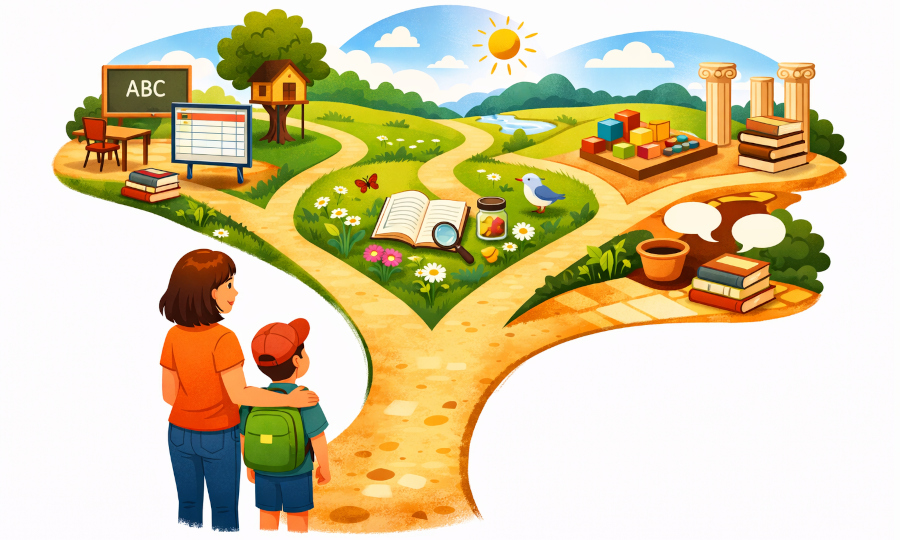
There are many ways to approach home education, and each has its own strengths. Here’s a practical overview for you to read through. If any of these approaches interest you in particular then go for a deeper dive afterwards.
A. Traditional / Structured Education
This approach mirrors many elements of institutional schooling, and there’s nothing wrong with starting here. Sometimes it’s a helpful bridge as you transition away from school routines and towards a more free and relaxed approach.
Key ideas:
-
Clear timetable
-
Subject-based learning
-
Parent-led instruction
-
Workbooks, curriculum plans, measurable progress
What it looks like at home:
-
Morning lessons focusing on core subjects like maths and English
-
Daily set activities
-
Occasional assessments or progress checks
-
Clear expectations for the child
Who it suits:
-
Parents who feel comfortable with structure
-
Children who thrive on routine and predictability
B. Child-Led / Unschooling
This philosophy, championed by John Holt, focuses on curiosity-driven learning rather than formal lessons.
Key ideas:
-
Learning flows from the child’s interests
-
No formal curriculum
-
Trust in natural development
-
Parent acts as facilitator: guiding resources and opportunities without enforcing a rigid plan
What it looks like at home:
-
Flexible days following children’s questions and interests
-
Real-world learning experiences
-
In-depth explorations of hobbies or topics
-
Conversations taking priority over worksheets
Who it suits:
-
Highly independent learners
-
Families valuing autonomy and creativity
C. Charlotte Mason Approach
Charlotte Mason promoted a philosophy based on short, focused lessons, living books, and respect for children as persons.
Key ideas:
-
Short, purposeful lessons
-
Use of rich literature (“living books”)
-
Nature study and outdoor observation
-
Habit formation
-
Narration instead of worksheets
What it looks like at home:
-
Reading aloud from high-quality books
-
Nature walks with sketchbooks or journals
-
Poetry memorisation
-
Gentle structure without long hours at a desk
D. Montessori-Inspired
Maria Montessori emphasised independence, hands-on learning, and respect for each child’s developmental stage.
Key ideas:
-
Prepared environment with accessible materials
-
Child-directed activity choices
-
Practical, hands-on learning
-
Parent as observer and guide
What it looks like at home:
-
Shelves at child height with materials within reach
-
Daily life and practical tasks as learning opportunities
-
Self-correcting learning materials
-
Observation and gentle guidance from the parent
E. Classical Education
Classical education emphasises the Trivium: grammar, logic, and rhetoric. It’s knowledge-rich and often strongly rooted in history and literature.
Key ideas:
-
Focus on mastering knowledge in stages
-
Critical thinking and logic development
-
Strong historical and literary foundation
What it looks like at home:
-
Timeline projects and memory work
-
Reading and discussion of historical texts
-
Debates and reasoning exercises
A consideration:
You don’t need to choose one philosophy exclusively. Many families blend approaches to suit different children, different ages, and different family rhythms. The goal isn’t to fit a label, the goal is to achieve confidence in how you educate.
Why Defining Your Own Philosophy Matters
Having a clear educational philosophy helps you to find a focus and direction for your home education. It helps you choose resources wisely, makes day-to-day decisions easier, and provides consistency for your children. It also prevents you from constantly switching methods every time you see another “perfect” homeschool on Instagram or Pinterest.
Without a philosophy, you risk borrowing everyone else’s ideas and losing sight of your own child’s needs. When you know what you value and why, decisions become simpler.
Practical Factors to Consider
When defining your philosophy, consider these practical elements:
A. Your Child’s Age and Stage
-
Early years may suit short, playful lessons and hands-on activities.
-
Older children may benefit from structured study, deep dives into subjects, or classical approaches.
-
Neurodiversity and attention span should also guide your choices.
B. Your Personality
-
Do you thrive on planning or prefer spontaneity?
-
Would structure give you calm, or feel restrictive?
-
Consider what you enjoy as your teaching style will influence your child’s experience.
C. Your Daily Rhythm
-
Working parents may need shorter, focused lessons or flexible scheduling.
-
Families with multiple children must balance different needs.
-
Travelling or lifestyle-focused families can integrate learning into everyday life.
D. Your Environment
-
Rural vs city living affects access to museums, home school co-operatives, or outdoor experiences.
-
Community networks or support groups can be crucial for social learning and shared resources.
E. Your Faith or Worldview
-
Some parents wish to incorporate a faith-based perspective or moral framework.
-
Others prefer secular learning with ethics or values embedded in life skills.
F. Long-Term Goals
-
Are exams or university a priority?
-
Is your focus more on life skills, creativity, or entrepreneurship?
-
Your philosophy should align with the end goals that you envision for your child.
How to Start Defining Your Own
Sometimes the best way to begin is to work backwards, starting with your end goals in mind. Ask yourself:
-
What kind of person do I want my child to be at 18?
-
What do I believe about motivation and how children learn?
-
Do I value knowledge accumulation or character development more?
-
What aspects of my own schooling frustrated me, and what would I do differently?
Once you’ve reflected, try writing a short Family Educational Philosophy of arround five or six sentences summarising your philosophy. This doesn’t need to be formal; it’s a guiding statement to revisit, refine, and let evolve as your children grow. This is also something, if home educating in England, that you could show to the Local Authority one day, if they ever approach you for an overview of your home education provision.
Conclusion
Home education gives you the freedom to design an approach that reflects your values, your child, and your family life. You are allowed to borrow from different philosophies, adapt ideas, and change your mind as you grow in confidence. Clarifying your educational philosophy brings calm, direction, and confidence to your home education day.
There is no single “right” way. What matters is that it works for your child and family, and that you feel grounded in your choices.
Home education isn’t about recreating school at the kitchen table. It’s about building an education that reflects your values, your child, and your life.
Other articles you might be interested in
Homeschool
Supporting Your Child’s Needs at Home: Using Maslow’s Pyramid
Learn how you, as home educating parents, can use Maslow’s Hierarchy of Needs

Homeschool
Motivation Matters: Intrinsic and Extrinsic Motivation in Home Education
Learn the difference between intrinsic and extrinsic motivation in home education a
Homeschool
Creating Your Learning Ethos at Home
Learn how to create a strong homeschooling learning ethos with practical tips for routines, r